
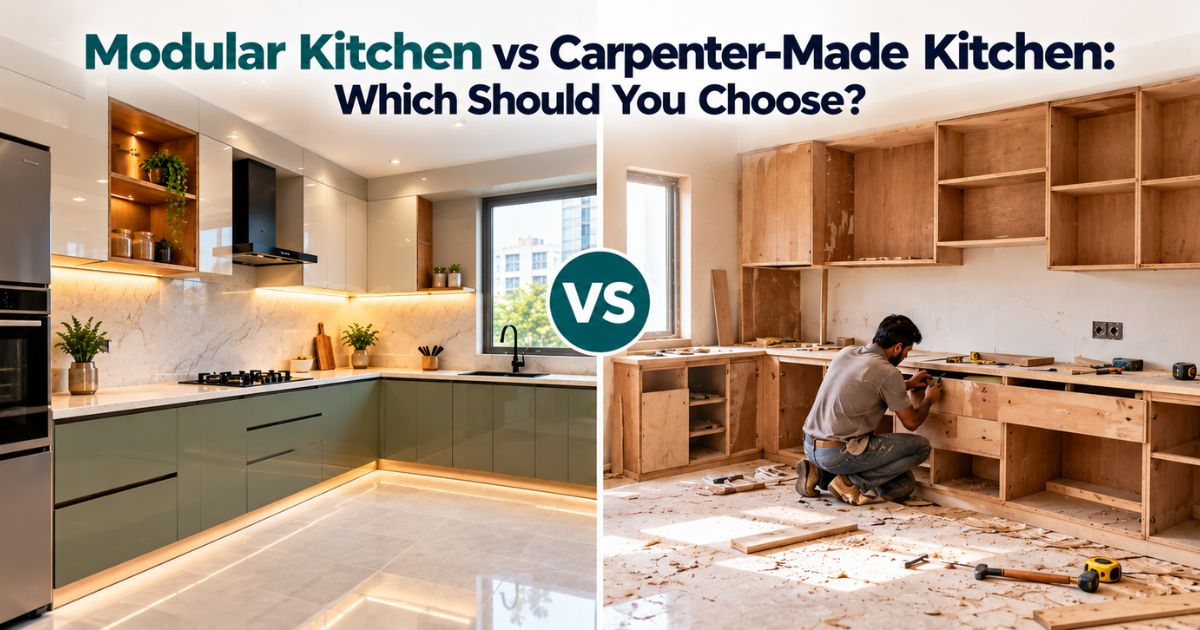
Modular Kitchen vs Carpenter-Made Kitchen: Which Should You Choose?
Page SEO Metadata
Target URL: /blog/modular-kitchen-vs-carpenter-made-kitchen/ (WordPress: Post/Blog)
Title Tag: Modular Kitchen vs Carpenter-Made Kitchen: Which Should You Choose? (69 characters)
Meta Description: Modular or carpenter-made? Compare durability, installation time, cost and finish before deciding on your kitchen. (118 characters)
H1: Modular Kitchen vs Carpenter-Made Kitchen: Which Should You Choose?
Primary Keyword: modular kitchen vs carpenter made kitchen
Secondary Keywords: difference between modular and carpenter made kitchen, is modular kitchen worth it
LSI / Related Terms: traditional kitchen india, modular kitchen durability, modular kitchen installation time, custom carpenter kitchen
Search Intent / Funnel Stage: Commercial Investigation — MOFU
Body Word Count: 1,124 words — verified by direct extraction of body paragraph + table text from the .docx XML
Research basis: Structured from real ranking-content research (Designcafe, Asian Paints Beautiful Homes, Truww, Homelane) via WebSearch, since AnswerThePublic isn’t connected in this session.
Modular Kitchen vs Carpenter-Made Kitchen: Which Should You Choose?
The Quick Answer
A modular kitchen uses factory-manufactured cabinet units assembled on-site, while a carpenter-made kitchen is built entirely by hand in your home from raw material. Modular generally wins on consistency, finish quality and installation speed; carpenter-made can offer more flexibility for odd-shaped spaces or very specific custom requests, but with more variability in execution quality depending on the individual carpenter. Neither is universally “better” — the right choice depends on what you’re optimising for.
What’s the Actual Difference
Modular kitchen components — cabinet boxes, shutters, drawers — are manufactured in a factory to precise, consistent specifications, then transported and assembled in your home. A carpenter-made kitchen is built on-site from scratch, with a carpenter cutting, joining and finishing the cabinetry by hand in your kitchen. This single difference in process is where most of the other differences — in consistency, time and finish — actually come from.
Durability Comparison
Factory manufacturing allows for consistent quality control — edge banding, joinery and finishing are done under controlled conditions, which generally produces more consistent durability across the full kitchen. Carpenter-made quality depends heavily on the individual carpenter’s skill, and can vary noticeably between different parts of the same kitchen if different workers handled different sections. Neither approach is inherently more durable in principle — a skilled carpenter using good material can build something that lasts as long as a modular kitchen — but modular manufacturing removes more of the variability.
Installation Time
This is one of the clearest practical differences. Because modular components are pre-manufactured, on-site installation typically takes days rather than weeks, since the work in your home is largely assembly rather than construction. Carpenter-made kitchens involve on-site cutting, joining and finishing, which generally takes considerably longer and creates more dust, noise and disruption in your home during the process.
Cost Comparison
Cost comparisons between the two aren’t straightforward, because both can range from budget to premium depending on material and finish choices. In general, modular kitchens have more predictable, itemised pricing since components are standardised, while carpenter-made costs depend more on negotiation with an individual carpenter and can be harder to pin down upfront. Neither is reliably cheaper than the other without comparing like-for-like material and scope.
Customisation and Flexibility
This is where carpenter-made kitchens can have a genuine advantage — a skilled carpenter can adapt to unusual room shapes, odd corners, or very specific custom requests that standard modular components aren’t designed for. Modern modular systems have become considerably more flexible than older catalogue-only models, with made-to-measure components now common, but a genuinely unusual space may still be better served by custom carpentry in some cases.
Finish Quality and Consistency
Factory-applied finishes — laminate, acrylic or PU — are generally more consistent in appearance than hand-finished carpentry, where variation in paint or polish application between different sections is more common. If a perfectly uniform, catalogue-quality finish matters to you, modular generally delivers this more reliably.
Maintenance and Repairs
Modular kitchens generally have an advantage here too — because components are standardised, a damaged drawer runner or hinge can often be replaced with a matching part without needing custom rework. Repairs on a carpenter-made kitchen typically require the same carpenter (or one who can match their specific work) back on-site, which can be harder to arrange years later, especially if the original carpenter is no longer available. This is worth factoring in beyond just the initial installation.
Resale and Long-Term Value
A consistently finished, well-maintained modular kitchen tends to present better to prospective buyers if you sell the home later, partly because the uniform factory finish ages more predictably than hand-applied carpentry finishes, which can show wear unevenly across different sections built by different workers or at different times.
Comparison at a Glance
| Factor | Modular Kitchen | Carpenter-Made Kitchen |
| Installation time | Typically days | Typically weeks |
| Consistency | High — factory-controlled | Depends on individual carpenter |
| Customisation for odd spaces | Good, with made-to-measure options | Highest — fully custom |
| Pricing clarity | More itemised and predictable | More variable, negotiation-based |
| Disruption during installation | Lower | Higher — on-site construction |
Which Should You Choose
If predictable timelines, consistent finish quality and itemised pricing matter most to you, modular is generally the stronger choice for most standard kitchen shapes. If your kitchen has a genuinely unusual layout that standard components can’t accommodate well, or you have very specific custom requirements, it’s worth discussing with a modular company first — many can now achieve far more customisation than older catalogue systems allowed, often without needing to go fully carpenter-made.
What BeBrick Buildwell Offers
We design and manufacture modular kitchen components in-house and install them directly, which means you get the consistency and installation speed of a modular system, combined with made-to-measure design during the site visit rather than a fixed catalogue. If your layout has unusual constraints, we assess that during the free site visit rather than assuming a standard kitchen fits.
Frequently Asked Questions
Is modular kitchen better than carpenter-made? Not universally — modular generally offers more consistency, faster installation and clearer pricing, while carpenter-made can offer more flexibility for unusual spaces. The right choice depends on your priorities.
How much faster is modular kitchen installation? Modular installation typically takes days since components are pre-manufactured, compared to weeks for a fully carpenter-built kitchen done on-site from scratch.
Is carpenter-made kitchen cheaper than modular? Not reliably — both range from budget to premium, and cost depends more on material and finish choices than on which approach you pick.
Can modular kitchens handle unusual room shapes? Modern modular systems with made-to-measure components handle far more unusual shapes than older catalogue-only systems, though a genuinely unusual layout is worth discussing directly during a site visit.
Is modular kitchen quality more consistent than carpenter-made? Generally yes, since factory manufacturing involves more controlled quality checks, while carpenter-made quality depends more on individual skill and can vary within the same kitchen.
Does a modular kitchen cause less disruption during installation? Yes — because most of the work happens in the factory beforehand, on-site installation is largely assembly, creating less dust, noise and disruption than fully on-site carpentry.
Are modular kitchen repairs easier than carpenter-made kitchen repairs? Generally yes, since standardised components can often be replaced with matching parts, whereas carpenter-made repairs usually depend on the original carpenter or one who can closely match their specific work.
Making the Right Call for Your Kitchen
Both approaches can produce a good kitchen. The better question isn’t which is objectively superior, but which fits your timeline, your room’s actual shape, and how much you value predictable, itemised pricing over maximum custom flexibility.
See our modular kitchen designer in Noida page, or book a free site visit to discuss what fits your space.
Implementation Notes for WordPress
Content type: WordPress Post (Blog), not a Page.
Schema to add: Article/BlogPosting schema, FAQPage schema for the 6 FAQs above.
Internal links to add: /modular-kitchen-designer-in-noida/ (final CTA line).
AEO / AI Overview optimization: the comparison table and ‘Quick Answer’ section are structured for direct AI Overview extraction on ‘modular vs carpenter kitchen’ style comparison queries.
Plagiarism / AI-detection: content is original, written specifically for this brief, informed by but not copied from researched source pages (Designcafe, Asian Paints Beautiful Homes, Truww, Homelane). Run through a plagiarism checker before publishing.