
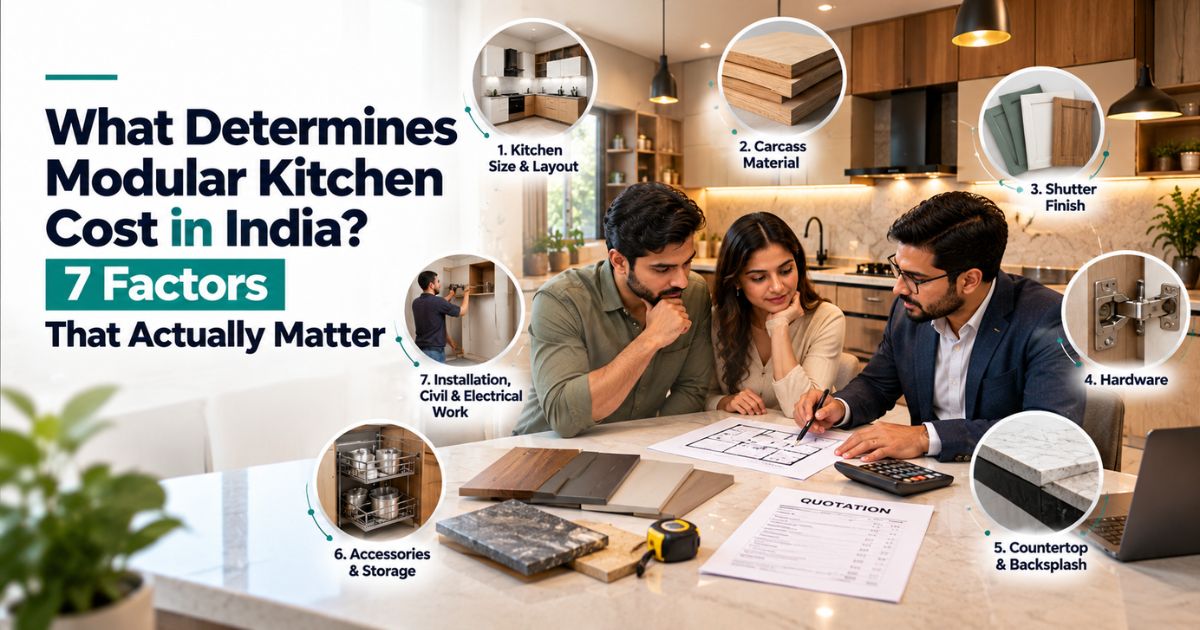
What Determines Modular Kitchen Cost in India? 7 Factors That Actually Matter
The Quick Answer
Modular kitchen cost varies too widely across India — by city, material choice and project scope — for a single number to mean much. What’s more useful is understanding the specific factors that drive the final price up or down, so you can read any quote you receive and know exactly what you’re paying for, rather than comparing headline numbers that may not represent the same scope.
1. Kitchen Size and Linear Footage
This is usually the single biggest driver of cost. Pricing is typically calculated per running foot of cabinetry, so a larger kitchen with more wall length in cabinets costs more than a compact one, independent of any other factor. This is also why comparing a quote for your kitchen against a friend’s quote for a differently sized kitchen tells you very little.
2. Material Grade — Carcass and Shutters
Cabinet carcass material (plywood grade — MR, BWR or BWP/marine) and shutter finish (laminate, acrylic or PU) both affect cost significantly, and two quotes using different grades can differ by a large margin while looking similar on paper. Our separate guide on plywood vs MDF vs particle board covers this in more detail if you want to understand what each grade actually means for durability, not just price.
3. Hardware Brand and Quality
Hinges, channels, baskets and drawer systems from established hardware brands cost more upfront than unbranded alternatives, but budget hardware is also the most common point of failure in modular kitchens within the first two to three years. This is a factor worth asking about specifically rather than assuming it’s included at a consistent standard across every quote.
4. Layout Type
A U-shaped layout generally uses more cabinetry and counter length than a straight-line layout for a similarly sized room, which directly affects material quantity and cost. Our guide on modular kitchen layout types covers which shape fits which kitchen size, which is worth deciding before comparing quotes based on cost alone.
5. Appliances and Built-In Fittings
- Chimney or exhaust hood — slim built-in options generally cost more than basic models
- Hob — gas, electric or induction, with a range of pricing within each type
- Built-in oven or microwave unit, if included
- Whether these are included in the headline quote or priced separately — a common source of quote confusion
6. Civil and Electrical Work
A new flat with existing plumbing and electrical points in the right places typically needs less additional work than a renovation of an older home, where wiring updates, plumbing changes or civil work to fix uneven walls can add meaningfully to the total project cost. This is part of why a site visit before quoting matters — these needs aren’t visible from a floor plan alone.
7. Finish and Accessories
- Soft-close hinges and channels versus standard ones
- Pull-out organisers, corner carousel units and other accessory add-ons
- Under-cabinet or accent lighting
- Handle style and finish — a small-looking choice that adds up across a full kitchen
Budget, Mid-Range and Premium — What Actually Changes
| Tier | Typical Material Grade | Typical Hardware | Typical Finish |
| Budget | MR or BWR grade plywood | Standard, unbranded or entry-level branded | Laminate |
| Mid-Range | BWP/marine grade plywood | Established mid-tier brands, soft-close standard | Laminate or acrylic |
| Premium | BWP/marine grade plywood throughout | Premium branded hardware, full soft-close | Acrylic or PU, more accessory options |
These tiers describe what changes, not a fixed number — the same tier can cost differently depending on kitchen size and city.
How to Compare Two Quotes Fairly
Side-by-side, two quotes for what seems like the “same” kitchen can differ by a wide margin and still both be honest — because they’re not actually quoting the same thing. Before comparing the final number, line up what each quote actually includes:
- Material grade specified for the carcass (plywood grade, or MDF/particle board) — not just the word “plywood” on its own
- Shutter finish named specifically — laminate, acrylic or PU — since this alone shifts cost noticeably
- Hardware brand named, not just described as “good quality”
- Whether appliances (chimney, hob) are included in the headline number or priced as add-ons
- Whether any civil or electrical work is included, excluded, or not yet assessed
Once these are lined up, the real gap between two quotes often looks very different from the first impression the headline numbers gave.
How to Get an Accurate Number for Your Kitchen
The only way to get a number that actually means something is a site visit and an itemised quote broken down by these factors — size, material, hardware, appliances and any civil work needed. A number given without seeing your kitchen is an estimate based on assumptions, not your actual project.
Frequently Asked Questions
What is the single biggest factor in modular kitchen cost? Kitchen size and linear footage of cabinetry is typically the largest driver, followed by material grade and hardware quality.
Why do two quotes for a similar-sized kitchen differ so much? They’re usually not quoting the same scope — different material grades, hardware brands, and whether appliances and civil work are included all affect the number significantly.
Does layout type affect cost? Yes — a U-shaped layout typically uses more cabinetry than a straight-line layout for a comparable room size, which increases material cost.
Is civil and electrical work usually included in a modular kitchen quote? This varies by company and should be confirmed upfront — some quotes include necessary civil/electrical work, others list it separately or exclude it entirely.
Can I get an accurate cost estimate without a site visit? Not a reliable one. A site visit lets a company assess your kitchen’s actual dimensions, existing points and condition, which a floor plan or phone conversation alone can’t capture.
Is a lower quote always a worse deal? Not necessarily, but it’s worth checking what’s excluded — material grade, hardware brand, and scope — before assuming a lower number means lower value.
Should I ask for the cost broken down by factor rather than one total number? Yes. An itemised quote broken down by material, hardware, appliances and labour makes it possible to see exactly where the cost comes from, and to adjust individual parts of the scope if your budget needs it.
What BeBrick Buildwell Does Differently
Every project starts with a free site visit and ends in an itemised quote broken down by exactly these factors — material grade, hardware, appliances and any civil work — rather than one lump-sum number. That way you can see precisely where the cost comes from and adjust scope if needed, rather than guessing what’s included.
See our modular kitchen designer in Noida page, or book a free site visit for an itemised quote built around your actual kitchen.
Implementation Notes for WordPress
Content type: WordPress Post (Blog), not a Page.
Schema to add: Article/BlogPosting schema, FAQPage schema for the 6 FAQs above.
Internal links to add: /modular-kitchen-designer-in-noida/ (final CTA), /blog/plywood-vs-mdf-vs-particle-board-modular-kitchen/ (material section), /blog/modular-kitchen-layout-types/ (layout section).
Pricing note: no fixed ₹ figures anywhere, consistent with standing rule — tiers described qualitatively only.
AEO / AI Overview optimization: the 7-factor structure and the tier table are built for direct AI Overview extraction on ‘what affects modular kitchen cost’ style queries.
Plagiarism / AI-detection: content is original, written specifically for this brief, informed by but not copied from researched source pages (BrickNBolt, Housing.com, Godrej Properties, InteriorCompany, Homelane). Run through a plagiarism checker before publishing.